
How to Compare Two Internet Plans Without Missing the Fees
Compare internet plans over the same period, including equipment, setup, promotion changes and exit costs. Use a worked example and a practical worksheet.

The short answer
Compare the full cost over the same number of months, then check upload, download, data limits and exit terms. A lower advertised price can still produce a higher bill.
A $50 internet plan looks cheaper than a $65 plan. Add equipment rental and installation, and it might not be.
The useful comparison is not the biggest speed beside the smallest price. It is what each offer costs for the time you expect to keep it, with the equipment and conditions you actually need.
Start with the Broadband Facts label and the provider’s written offer. Then do one calculation for each plan. You do not need a spreadsheet subscription or a guess about what your bill might be.
First, make sure both offers apply to your address
Enter the same service address on each provider’s website. An offer for a nearby neighborhood or a new customer may not be available to you.
The FCC broadband map can help identify providers reporting service at your location. Confirm availability and the specific offer with the provider before arranging installation or canceling anything.
Save the label, checkout quote and terms with the date. A screenshot of an advertisement alone may miss the conditions attached to it.
Read the label and checkout quote together
A Broadband Facts label gives you a common starting point: price, introductory terms, fees, typical speeds and data allowances. The FCC’s published label template shows these categories. It is a reference template, not a quote for your address or a guarantee that today’s layout is identical.
Do not assume a displayed monthly price includes every charge or discount. AT&T’s explanation of its labels distinguishes the listed price from offers, promotions and government taxes. Read the actual offer you are considering rather than applying one provider’s presentation to another.
Use this worksheet for both plans:
| Write down | Question to answer |
|---|---|
| Starting service price | Is this the price I qualify for at this address? |
| Promotion | How many months does it last, and what happens afterward? |
| Recurring extras | Is equipment included, optional or charged separately? |
| Discounts | Does the price require autopay, a particular payment method or another service? |
| One-time charges | What will installation, activation or equipment purchase cost? |
| Taxes and other charges | What is additional, and which amounts are not yet known? |
| Exit terms | Is there a contract, cancellation charge or equipment-return deadline? |
Ask whether each extra is already included before adding it. Counting the same equipment charge twice is just as misleading as forgetting it.
If checkout and the label disagree, ask the provider for a written explanation before confirming the order. Keep unresolved charges marked as unknown, not zero.
Work through the same 24 months
Here are two made-up offers. They demonstrate the method, not available prices or provider recommendations.
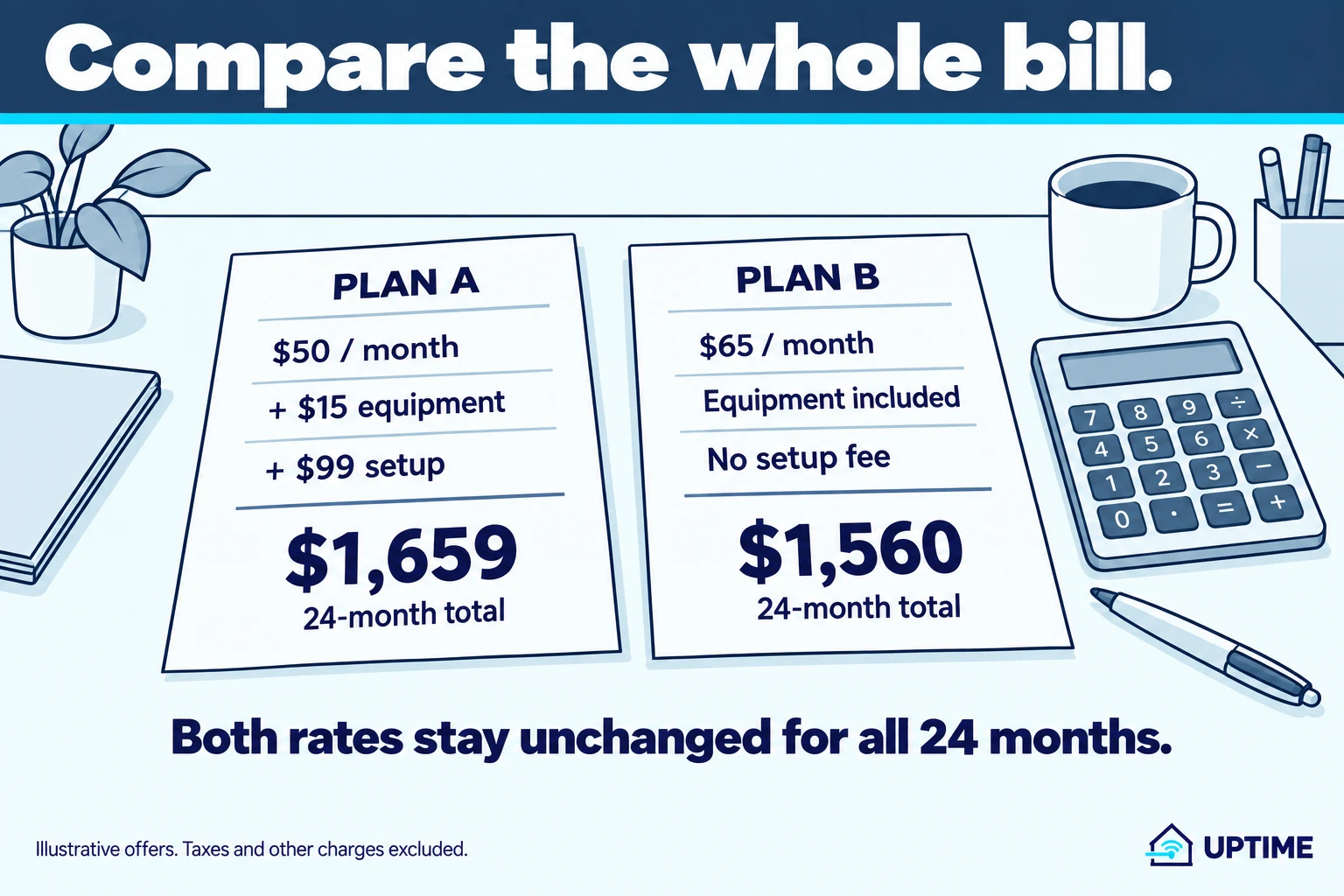
Plan A: $50 per month for 24 months, then $70. Equipment costs another $15 per month. Installation is $99.
Plan B: $65 per month throughout those same 24 months, including equipment, with no setup charge.
Assume no additional discounts, usage charges or early cancellation. Taxes and other charges are excluded from this example.
Compare the whole bill over the same number of months.
| Cost across 24 months | Plan A | Plan B |
|---|---|---|
| Service, months 1–12 | $50 × 12 = $600 | $65 × 12 = $780 |
| Service, months 13–24 | $50 × 12 = $600 | $65 × 12 = $780 |
| Equipment | $15 × 24 = $360 | Included |
| Installation | $99 | $0 |
| Total | $1,659 | $1,560 |
| Average per month | $69.13, rounded | $65.00 |
Plan A costs $99 more over those two years. Its $70 post-promotion rate starts in month 25, so it does not belong in this calculation.
If you expect to stay for three years, add a third year at the applicable rates. Assuming equipment remains $15 and Plan B stays $65, the totals become $2,679 and $2,340: a $339 difference. Those are assumptions to verify, not promises about future pricing.
For your own comparison, use:
Service charges for each price period + recurring extras + one-time charges + expected usage or exit charges − discounts you actually qualify for.
A promotion ending after 12 months needs two service-price periods in a two-year comparison. One ending after 24 months does not. Write the start and end month beside each rate before multiplying.
Check whether the speed upgrade solves your problem
Keep download, upload and latency in separate columns. A plan with a large download figure can still have a much smaller upload allowance.
| Your main problem | Compare or investigate |
|---|---|
| Large downloads take too long | Download speed, assuming the home network and remote service can keep up |
| Several people upload or join calls together | Upload as well as download capacity |
| Calls feel delayed or unstable | Latency and connection consistency, not just headline speed |
| One room is slow while others work well | Wi-Fi coverage and the device connection first |
Typical figures are not a guaranteed speed at every device. A plan comparison cannot tell you how a signal travels through your walls.
If you are unsure what capacity your household needs, use our internet-speed guide. If the problem changes by room, start with the slow Wi-Fi checks before buying a faster package.
Put data limits and equipment into the calculation
Look at your recent usage in your current provider’s account. Include a busy month, not only the quietest one. Compare that with the new plan’s allowance and the actual overage or reduced-service terms.
Do not automatically multiply every excess gigabyte by a guessed rate. Providers can use blocks, caps or different remedies. Copy the rule for that offer and calculate a realistic busy-month example.
For equipment, compare the rental with the complete cost of an approved alternative. Confirm compatibility, whether you need a modem as well as a router, and whether using your own equipment changes support or included features. Owning a router does not automatically mean you can avoid every equipment charge.
Treat a bundle similarly. A discount on internet is not a saving if it requires an additional service you would otherwise cancel. Compare the household’s combined cost with and without the bundle.
Find the cost of leaving
Before signing, answer three questions:
- What happens if I cancel before the promotion or contract ends?
- Which equipment must I return, how and by when?
- Could switching leave me paying for both services temporarily?
Use your likely situation. A two-year saving matters less if you expect to move in six months and the exit charge consumes it. Keep proof of equipment return and the final bill after switching.
Your comparison is ready when
- Both offers are confirmed for the same address and customer eligibility.
- Both totals cover the same number of months, with promotion changes in the correct months.
- Equipment, setup, discounts and known additional charges are counted once.
- Upload, download and data terms fit your actual use.
- Cancellation and return terms are saved alongside the quote.
Keep the worksheet until the first bill arrives. Compare the actual line items with the offer, allowing for explained partial-month charges or setup costs. Question differences rather than assuming every first-bill charge must appear as a fixed amount on the label.
The goal is a plan you can explain in one sentence: what you pay, for how long, and what changes afterward.

Internet Plans & Speed
How Much Internet Speed Do You Actually Need?
Work out your download and upload needs, compare 100 Mbps with faster plans, and check whether a cheaper internet plan would actually save you money.

Wi-Fi & Networking
How to Fix Slow Wi-Fi Without Buying Anything
Find out why your Wi-Fi is slow, then test router placement, extenders, bands, channels, and updates before paying for new equipment or a faster plan.

Internet Plans & Speed
Why a Fast Download Speed Can Still Mean a Bad Video Call
Fast downloads do not guarantee clear calls. Check upload, Wi-Fi, competing traffic and in-call statistics with a repeatable troubleshooting sequence.

About the author
Doni makes home tech understandable.
Uptime turns the answers he gives friends and family into practical public guides. Research assistance and editing tools may be used; claims are checked against named sources and no hands-on testing is implied unless stated.